
Tools & Resources · Municipal Guide
Opioid Overdose Prevention Municipal Guide & Workbook
A bird’s-eye view to help Connecticut communities use opioid settlement funds and other prevention resources to keep residents safe. Download the full guide, grab just the section you need, or start planning with the fillable Quick Start Tools.
Who it’s for
Built for municipal & community leaders
For Connecticut leaders who coordinate local services, guide opioid settlement fund investments, or build a community-wide prevention and response system.
Municipal leadership & administration
Chief elected officials, municipal managers, councils and boards, finance, legal, HR, procurement and communications.
Public health & public safety
Local health departments and districts, police, fire, EMS, emergency management and response partners.
Human services, schools & community
Social services, housing, youth services, parks and recreation, education and community development.
Prevention, healthcare & partners
Local Prevention Councils, coalitions, task forces, treatment and recovery providers, and people with lived experience.
The planning cycle
Six steps from planning to action
Start where your community is today. Each step links to its guide section and the matching Quick Start Tool.
Then sustain it: Sustainability & Alignment + Tool 9 connect opioid work with existing prevention strategies.
The guide
Browse the guide by section
Download the whole workbook, or grab only the pages you need for a meeting, briefing or planning session.
Complete guide · 32 pages · PDF
Opioid Overdose Prevention Municipal Guide and Workbook
All 13 guide sections, Connecticut success stories, and the 9 Quick Start Tools in a single print-ready file.
Foundations · Pages 3–4
Why Opioid Overdose Prevention Matters
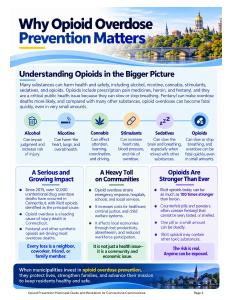
Opioids in the bigger substance-use picture, the toll on Connecticut communities, and the tools towns already have — settlement funds, LPCs and partners.
Foundations · Pages 5–8
Municipal Government Role & Roadmap
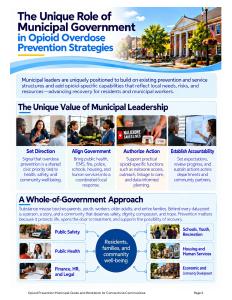
How municipal leaders set direction, align departments and authorize action — plus the seven levers: direct, fund, contract, convene, set policy, communicate, advocate.
Foundations · Pages 9–10
Supply & Demand Framework
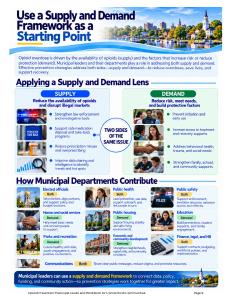
Two sides of the same issue, how each department contributes, and the Build On + Add + Enable approach to getting started.
Foundations · Page 13
Settlement Fund Uses & Municipal Departments
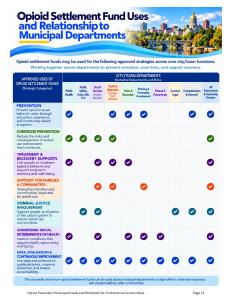
A one-page crosswalk of approved settlement fund strategies against city and town departments — useful for budget and council conversations.
Step 1 · Pages 11–12
Key Questions, Leaders & Partners
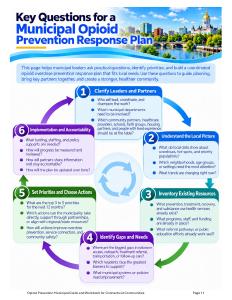
The six key questions for a municipal plan, and how to choose who leads, coordinates and sits at the table.
Step 2 · Page 14
Understand the Local Picture
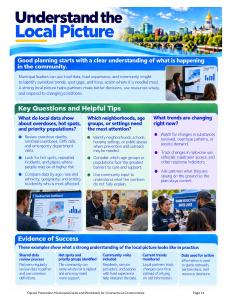
Use local data and community experience to see what’s happening, who is most affected and what’s changing.
Step 3 · Page 15
Inventory Existing Resources
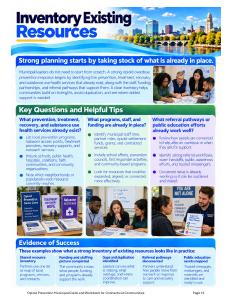
Map current prevention, treatment, recovery and response services — and where settlement funds already support them.
Step 4 · Page 16
Identify Gaps & Needs
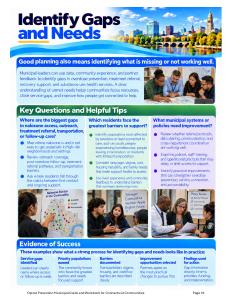
Find gaps in naloxone access, outreach, referral, transportation and follow-up care, and the barriers residents face.
Step 5 · Page 17
Set Priorities & Choose Actions
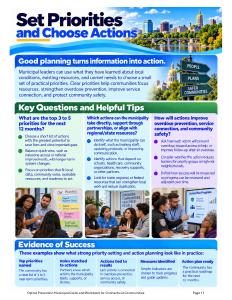
Narrow to the top 3 to 5 priorities and a focused 12-month action agenda, balancing quick wins with system change.
Step 6 · Page 18
Implementation & Accountability
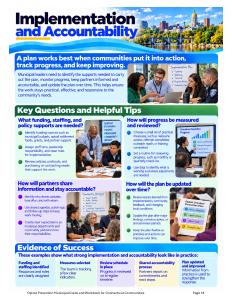
Name owners, timing, support and measures, and set a review routine that keeps the plan current.
Sustain · Page 19
Sustainability & Alignment
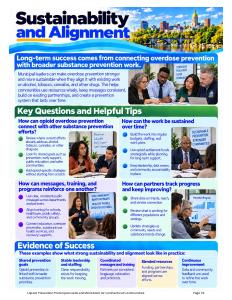
Connect overdose prevention with broader alcohol, tobacco and cannabis prevention so the work lasts.
Action · Page 20
Turning the Planning Cycle into Action
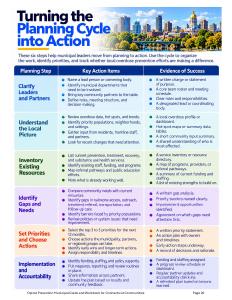
A one-page table of key action items and evidence of success for every step — a handy checklist for a planning team.
Action · Pages 21–22
Success Stories Across the Planning Cycle
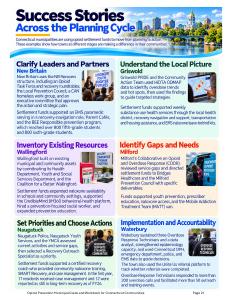
How twelve Connecticut municipalities are using settlement funds at every stage, from New Britain to Ashford.
Quick Start Tools · Pages 23–32
Fillable planning worksheets
Practical starting points your planning team can fill in on screen, save and share. Use them in sequence, or pick only the ones that fit your community’s current stage of work.
Tip: open fillable PDFs in Adobe Acrobat Reader so your entries save. Some browser PDF viewers don’t keep form data.
Point of Contact & Planning Team Worksheet
Name the staff and subject matter experts who will help build and carry out the plan.
Existing Community Efforts & Alignment
Scan for councils, coalitions and task forces already doing this work.
Sample Collaboration Charter & MOA
Agree on purpose, roles, decision-making and accountability.
Community Snapshot & Data Map
Build a shared working picture before choosing a strategy.
Inventory Existing Resources & Settlement Funds
Document programs, funding sources and current settlement fund uses.
Set Priorities & Choose Actions
Turn top needs into a focused 12-month action agenda.
Implementation & Accountability
Make ownership, timing, support and measures visible.
Integration & Alignment
Connect opioid work with existing prevention strategies.
Connecticut in action
Towns already doing this work
Municipalities at every stage of the cycle are putting settlement funds to work. Read the full stories on pages 21–22.
New Britain
NB Recovers structure with a task force and LPC; prevention reached 1,600+ students.
Griswold
Used ODMAP data to find trends and hot spots, then targeted strategies.
Wallingford
Coordinated existing departments; expanded naloxone in schools and community settings.
Milford
Gap review funded youth prevention, prescriber education and the MATT van.
Naugatuck
Prioritized a recovery outreach specialist and case management.
Waterbury
Overdose Response Technicians answered 200+ calls; referrals tracked end to end.
For municipal leaders and partners
How to use this guide
Start where you are
Jump to the planning step that matches your community today. You don’t have to start at page one.
Fill in the worksheets together
The Quick Start Tools give your planning team a shared record of decisions, owners and next steps.
Bring a section to the meeting
Section PDFs are sized for council briefings, department meetings and coalition agendas.
Ask for support
TTASC provides training and technical assistance on putting the plan into practice.
Related
Where to go next
TTASC
Opioid Fact Sheet
Connecticut data, fentanyl and xylazine, MOUD, naloxone and the Good Samaritan Law.
Connecticut
CT Opioid Settlement Resources
State guidance on approved uses and reporting for municipal settlement funds.
This guide was developed by the Connecticut Prevention Training and Technical Assistance Service Center with financial support from funding to CT DMHAS from SAMHSA Grant Number 1H79TI087736-01 for State Opioid Response.