
Opioid Stigma
Identification & Reduction
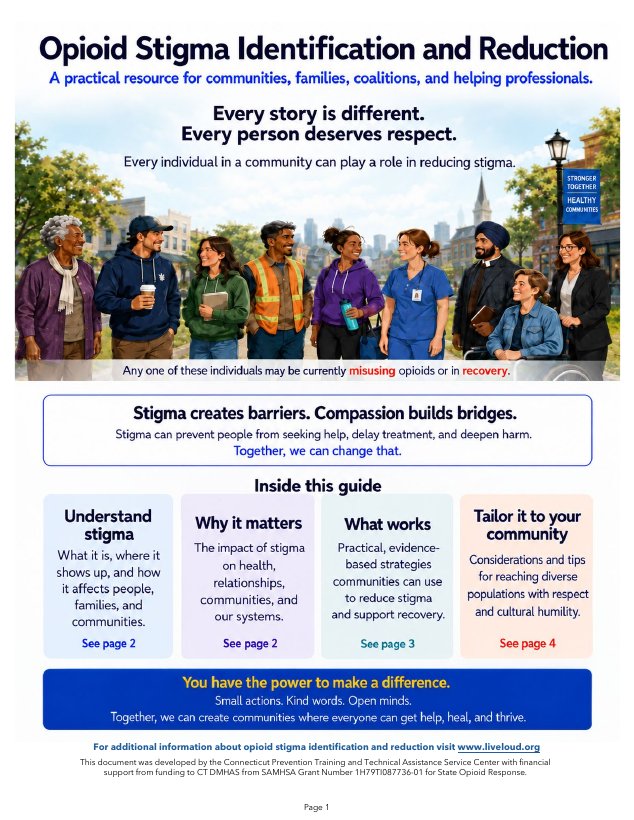
A practical resource for communities, families, coalitions and helping professionals. Learn how to spot stigma in words, rules and systems, and use proven strategies to make it easier for people to seek help, heal and thrive.
 Free PDF
Stigma creates barriers. Compassion builds bridges.
Stigma can keep people from seeking help, delay treatment and deepen harm. Every individual in a community can play a role in reducing it.
Every story is different. Every person deserves respect.
The guide is organized in four parts. Jump to any section below for the highlights, or download the full PDF.
Understand stigma
What it is, where it shows up, and how it affects people, families and communities.
Page 2 → 02Why it matters
The impact of stigma on health, relationships, communities and our systems.
Page 2 → 03What works
Practical, evidence-based strategies communities can use to reduce stigma and support recovery.
Page 3 → 04Tailor it to your community
Tips for reaching diverse populations with respect and cultural humility.
Page 4 →What stigma means
Opioid stigma is when negative labels, stereotypes, judgments or rules make people who use opioids or have opioid use disorder feel devalued or unwelcome. It can lead to shame, discrimination and barriers to care. Opioid use disorder is treatable, and stigma is preventable.
In how we treat others
Labels, jokes, blame, fear or social distancing.
In how people see themselves
Shame, secrecy, hopelessness or feeling undeserving of care.
In policies and systems
Practices that make medications for opioid use disorder, naloxone, overdose prevention, housing or care harder to access.
Layered with other stigma
Overlap with racism, LGBTQ+ stigma, disability, poverty, rural visibility or justice involvement.
How stigma causes harm
Labels and fear
Stereotypes and blame can make people feel judged, unsafe or unwelcome. People experience stigma differently based on identity, culture and lived context.
Shame and mistrust
Fear of judgment, loss or consequences can reduce trust, increase secrecy and make it harder to ask for help.
Delayed help
Stigma can lead to less disclosure and make prevention, treatment, naloxone, recovery support and other care harder to reach.
Wider impacts
Stigma can strain families, increase isolation, weaken community prevention and contribute to more emergency visits, justice involvement, lost work and avoidable costs.
Stigma is not just an attitude. It becomes a public health problem when it changes who is welcomed, believed, referred, treated or given another chance.
How to identify stigma
Use these questions to review your materials, programs, meetings and policies.
- Do our words describe a person — not define them by a condition?
- Would this feel respectful if someone with lived experience were in the room?
- Do our rules create avoidable barriers to treatment and recovery support?
- Do we discuss medications for opioid use disorder, naloxone and overdose prevention as care?
- Do our images or stories imply blame, crime, danger or hopelessness?
- Is privacy and personal information protected appropriately?
Would this message make someone feel safer — or more judged?
One question that works for a flyer, a social post, an intake form or a board presentation.
Strategies that help reduce stigma
Make the first contact feel safe
Use welcoming, nonjudgmental spaces. Protect privacy. Remove unnecessary paperwork and abstinence-only entry rules.
Check the rules
Review forms, referral criteria, discharge practices and communications for avoidable barriers.
Use words that show respect
Replace blame-based labels with person-first, clinically accurate terms. Words shape trust and willingness to seek care.
Put lived experience at the table
Develop messages, services and policies with people who have lived or living experience, and compensate that expertise when possible.
Frame help as health care
Present naloxone, substance use health services and medications for opioid use disorder as legitimate health care — not as failure.
Train for real-world skills
Pair awareness training with compassionate communication, bias reflection and difficult-conversation practice.
Prescription medication safety
Promote safe use, secure storage and proper disposal of unused opioids. Clear guidance reduces misuse risk without shame.
People are more likely to seek help when they feel respected, safe and believed.
Tailor strategies to the community
Different communities experience stigma in different ways, face unique barriers and have different strengths. Tailored approaches help people feel respected, understood and more likely to seek help.
Priority populations in communities
Acknowledge the existence of factors such as racism, medical mistrust and unequal criminalization. Partner with trusted community leaders.
Pair this with the six identification questions above when planning outreach for this group.
Indigenous / Tribal communities
Honor Tribal sovereignty and community-defined healing. Recognize historical trauma and integrate cultural practices when desired.
Pair this with the six identification questions above when planning outreach for this group.
LGBTQ+ community
Use correct names and pronouns, protect confidentiality, and create affirming spaces that recognize stress and past discrimination.
Pair this with the six identification questions above when planning outreach for this group.
Rural / small communities
Plan for privacy concerns, transportation barriers and limited services. Use trusted local partners and low-barrier referrals.
Pair this with the six identification questions above when planning outreach for this group.
Faith + spiritual communities
Frame opioid use disorder as a health condition. Equip faith leaders with facts, language and referral pathways that take into account values and belief systems.
Pair this with the six identification questions above when planning outreach for this group.
Jobs with high physical demands
Address pain, injury and pressure to “push through.” Promote safe pain management, early treatment and supportive return-to-work policies.
Pair this with the six identification questions above when planning outreach for this group.
Recovery Friendly Workplaces
Reduce stigma through peer champions (Recovery Coaches), clear policies and access to confidential support and treatment — including employee assistance programs (EAPs).
Pair this with the six identification questions above when planning outreach for this group.
Athletes and injury recovery
Normalize treatment for pain and mental health. Emphasize safe recovery, performance goals and support from coaches and medical staff.
Pair this with the six identification questions above when planning outreach for this group.
Tailor strategies to meet the unique needs, strengths and experiences of every community.
How to use this guide
Audit your materials
Run flyers, posts, forms and signage through the six identification questions before they go out.
Print and share
The PDF is print-ready for trainings, tabling events, waiting rooms and faith or workplace settings.
Open a conversation
Use the strategies page as a discussion tool with your board, staff or coalition sectors.
Ask for support
TTASC provides training and technical assistance on putting stigma-reduction strategies into practice.
Where to go next
Live LOUD
More on identifying and reducing opioid stigma, with real stories of recovery.
View → TTASCPrevention Fact Sheets
Connecticut opioid and stimulant data, naloxone and overdose response.
View → TTASCA Parent's Guide to Opioid Use Prevention
Conversation tips and warning signs for families.
View → ConnecticutDMHAS & RBHAOs
Prevention support, free naloxone and training across the state.
View →This guide was developed by the Connecticut Prevention Training and Technical Assistance Service Center with financial support from funding to CT DMHAS from SAMHSA Grant Number 1H79TI087736-01 for State Opioid Response. For education only, and not a substitute for professional medical advice.